Holocaust Holiday by Rabbi Shmuley Boteach
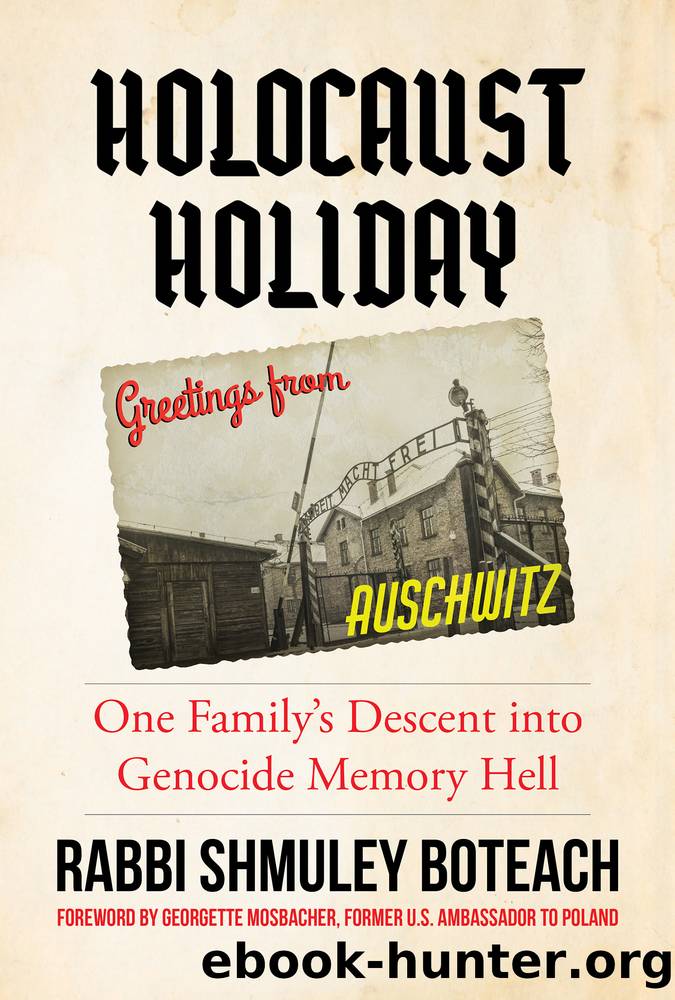
Author:Rabbi Shmuley Boteach [Boteach, Rabbi Shmuley]
Language: eng
Format: epub
ISBN: 9781642937817
Publisher: Post Hill Press
Published: 2021-03-22T13:33:09+00:00
CHAPTER 15
Lublin: Europeâs Greatest Yeshiva, Vanished, and a Mound of Jewish Bones
In the picturesque town of Lublin, where are arrived on July 6, there remain only a handful of Jews. Lublin was once one the most important centers of Jewish life, commerce, culture, and scholarship in Europe, going all the way back to the 14th century. In 1515, the worldâs largest Talmudic school was established by Shalom Shachna, and the renown of its scholars was appreciated, even by the Polish kings, who granted sages of the yeshiva rights equal to those of scholars in Polish universities. They called it the âJewish Oxford.â
The kids were in a better mood today. Yes, we had to snack on potato chips and vegetables. But moving on to a new city, one they had heard of as a great place of Jewish learning, made them eager to discover its history.
In 1567, the Maharshal Shul was built. It was also during this active century of Jewish life that the Council of the Four Lands, the ruling political body for Jews in Poland and Lithuania, was headquartered in Lublin. By the beginning of the 17th century, approximately two thousand Jews lived in Lublin, but it wasnât what you would call a safe place. Jews were accused of blood libels (using the blood of non-Jews for making matzoh on Passover) and attacked. Cossacks burned down the Jewish quarter in 1655, and killed more than two thousand people. It took more than a century before the community recovered. By 1787, the Jewish district was rebuilt and had a population of thirty-five hundred.
During the late 18th century, Lublin became a center for Hasidism, best known as the home of Jacob Isaac ha-Hozeh, better known as the Seer of Lublin. While blind, it was said that he could see directly into peopleâs souls. He died mysteriously, by falling out of his window.
Inter-religious tensions flared between the Hasidim and their opponents, known as Mitnagdim, and both groups maintained their own schools and synagogues. The Hasidim emphasized ecstatic and mystical devotion to God, and appealed to the less learned and the blue collar. The Mitnagdim emphasized scholarship, and looked down upon unlearned Jews, as peasants. Paradoxically, it was the Seer of Lublin who had one of the most profound quotations about belief: âCan He be God if He can only be worshipped in one way?â
Jews became increasingly prominent in business in the 19th century. A Jew owned the largest cigarette factory, and Jews owned 95 percent of businesses in the tanning industry. In 1877, the opening of a railway connecting Lublin with Warsaw contributed to an economic boom. A Jewish hospital opened in 1886, and a Hebrew school in 1897. As the 20th century began, the community was twenty-four thousand strong, nearly one-third of the population of Lublin. In addition to Yiddish newspapers, the first Jewish magazine was published, and a Jewish public library opened. Jews became active in the Zionist movement and the Bund, and various social, cultural, educational, and recreational institutions served the community.
Download
This site does not store any files on its server. We only index and link to content provided by other sites. Please contact the content providers to delete copyright contents if any and email us, we'll remove relevant links or contents immediately.
The Vikings: Conquering England, France, and Ireland by Wernick Robert(84591)
Ali Pasha, Lion of Ioannina by Eugenia Russell & Eugenia Russell(40381)
The Conquerors (The Winning of America Series Book 3) by Eckert Allan W(39076)
The Vikings: Discoverers of a New World by Wernick Robert(37048)
Cecilia; Or, Memoirs of an Heiress — Volume 1 by Fanny Burney(32721)
Cecilia; Or, Memoirs of an Heiress — Volume 2 by Fanny Burney(32089)
Cecilia; Or, Memoirs of an Heiress — Volume 3 by Fanny Burney(32066)
Empire of the Sikhs by Patwant Singh(23204)
The Secret History by Donna Tartt(19470)
Hans Sturm: A Soldier's Odyssey on the Eastern Front by Gordon Williamson(18724)
Cat's cradle by Kurt Vonnegut(15556)
Pimp by Iceberg Slim(14796)
Sapiens: A Brief History of Humankind by Yuval Noah Harari(14553)
Norse Mythology by Gaiman Neil(13566)
Talking to Strangers by Malcolm Gladwell(13541)
Leonardo da Vinci by Walter Isaacson(13509)
4 3 2 1: A Novel by Paul Auster(12612)
Underground: A Human History of the Worlds Beneath Our Feet by Will Hunt(12231)
The Radium Girls by Kate Moore(12180)
